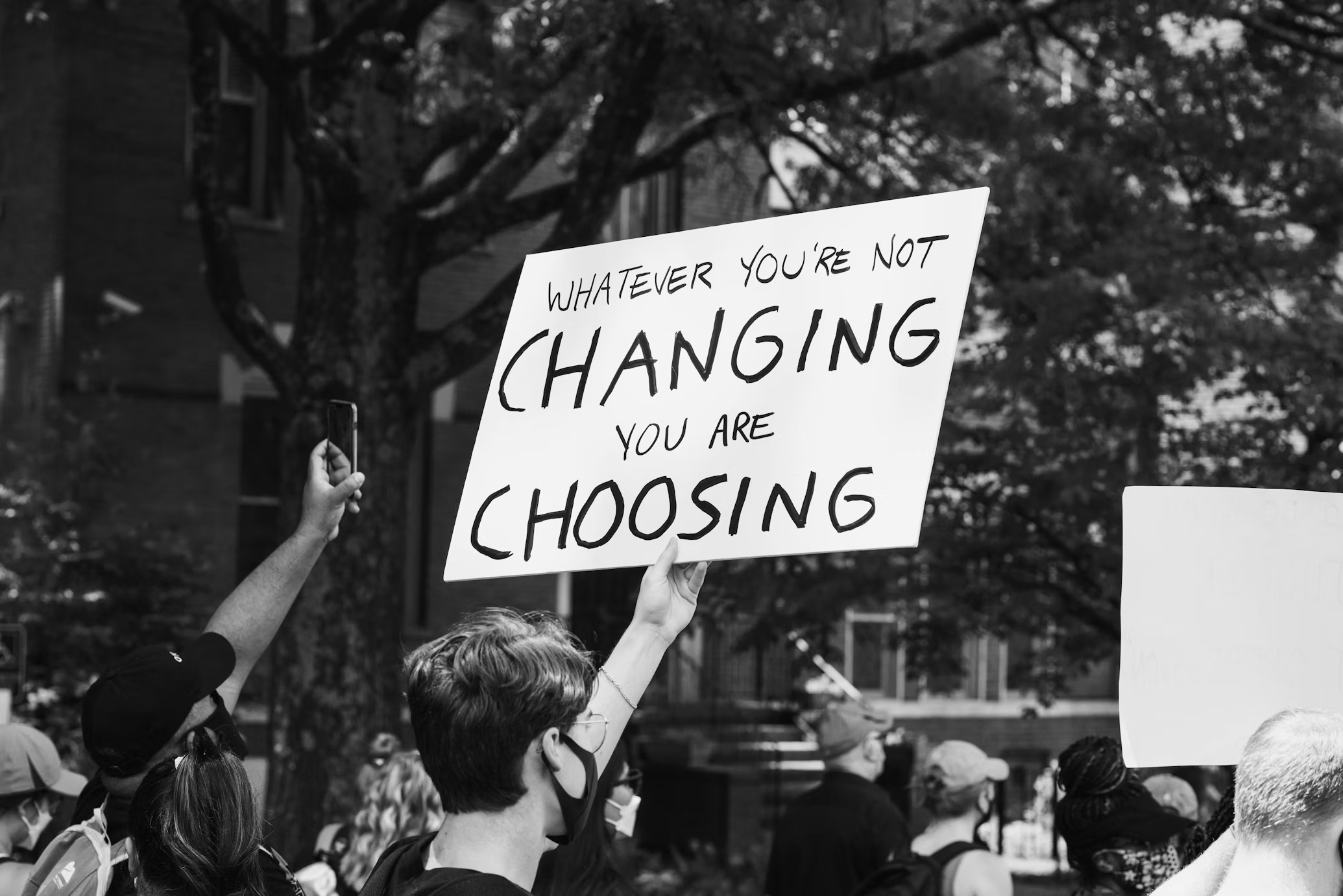
We often hear that having more choices means having more freedom. It sounds logical. If you have hundreds of options instead of just a few, you should be able to find exactly what you want. Whether you’re shopping for a new phone, choosing a career, selecting a college, or even looking for a life partner, modern society tells us that more options increase our chances of making the perfect decision.
Yet many people are discovering the opposite.
Instead of feeling empowered by endless possibilities, they feel exhausted. Choosing something as simple as a streaming show can take longer than actually watching it. Shopping online becomes an endless cycle of comparing prices, reading reviews, and worrying about making the wrong purchase. Dating apps offer thousands of potential matches, yet many users report feeling more frustrated and less satisfied than ever before.
Why does something that promises freedom so often leave us feeling anxious?
Psychologists have spent decades studying this question, and their findings reveal one of the most fascinating ideas in modern behavioral science: the Paradox of Choice. The theory suggests that while having some choices improves our lives, having too many choices can increase stress, reduce satisfaction, create decision fatigue, and leave us constantly wondering whether we could have made a better decision.
Understanding this psychological paradox helps explain why so many people today feel mentally overwhelmed despite living in a world filled with opportunities.
Table of Contents
- 1 What Is the Paradox of Choice?
- 2 Why Our Brains Struggle With Too Many Choices
- 3 1. Analysis Paralysis: When Too Many Options Stop Us From Choosing
- 4 2. Why Every Choice Creates Regret
- 5 3. The Impossible Search for Perfection
- 6 4. Why We Blame Ourselves More Than Ever
- 7 5. How Too Many Choices Affect Our Relationships
- 8 6. Why Career Choices Feel More Overwhelming Than Ever
- 9 7. Social Media Has Multiplied Our Decisions
- 10 8. Why We Regret Our Decisions Even When They Are Good
- 11 How to Make Better Decisions Without Feeling Overwhelmed
- 12 Final Thoughts
- 13 Frequently Asked Questions
What Is the Paradox of Choice?
The Paradox of Choice is a psychological concept made widely known by psychologist Barry Schwartz. It explains that although freedom of choice is important, an excessive number of options often makes decision-making more difficult rather than easier.
When choices are limited, our brains process information efficiently. We compare a few alternatives, make a reasonable decision, and move on.
When dozens—or even hundreds—of options are available, our brains work much harder. We begin comparing every detail, imagining every possible outcome, and worrying about what we might lose by choosing one option over another.
Instead of increasing happiness, too many possibilities often create uncertainty.
Ironically, having unlimited choices can make us feel less free because we become trapped in the endless search for the “perfect” option.
Why Our Brains Struggle With Too Many Choices
Human brains evolved in environments where choices were relatively simple. Our ancestors rarely had to compare fifty breakfast cereals, hundreds of television channels, or thousands of online products.
Modern life demands far more mental energy than our decision-making systems were originally designed to handle.
Every decision consumes cognitive resources. Psychologists call this decision fatigue. The more choices we make throughout the day, the harder it becomes to make thoughtful decisions later.
This is why even highly successful people often simplify parts of their daily routine. Many wear similar clothes every day, eat similar breakfasts, or follow structured schedules. They understand that reducing unnecessary decisions preserves mental energy for more important ones.
The problem is not that our brains are weak.
The problem is that modern life asks them to process an overwhelming number of choices every single day.
1. Analysis Paralysis: When Too Many Options Stop Us From Choosing
One of the most common consequences of excessive choice is analysis paralysis.
Imagine standing in a supermarket trying to buy olive oil. Instead of finding three bottles, you discover forty. Some are organic. Others are imported. Some are extra virgin, cold-pressed, infused with herbs, or produced by different regions around the world.
Instead of choosing confidently, you begin comparing labels, prices, ingredients, reviews, and health claims.
After several minutes, many people either buy nothing or leave feeling uncertain about the decision they finally made.
This same psychological pattern appears in much bigger life decisions.
People postpone changing careers because too many opportunities exist.
Students delay choosing university programs because every option seems to close the door on another future.
Entrepreneurs spend months researching instead of launching.
When options multiply, action often decreases.
Sometimes the greatest obstacle to making a decision isn’t lack of information.
It’s having too much of it.
2. Why Every Choice Creates Regret
Every decision carries something psychologists call an opportunity cost.
Choosing one option automatically means giving up every alternative.
When only two choices exist, the cost feels relatively small.
When hundreds of choices exist, the number of possibilities we leave behind becomes enormous.
Imagine booking a vacation.
Years ago, you might have chosen between two destinations.
Today you can compare thousands of hotels, flights, travel packages, rental homes, reviews, videos, and travel influencers’ recommendations.
Even after making a wonderful choice, it’s easy to wonder whether another destination would have been cheaper, more beautiful, or more memorable.
The more alternatives we imagine, the harder it becomes to fully appreciate what we already have.
This constant comparison quietly steals satisfaction from experiences that would otherwise bring genuine happiness.
3. The Impossible Search for Perfection
Having endless options changes not only our decisions but also our expectations.
If a store offers three winter jackets, most people hope to find one that fits reasonably well.
If the store offers three hundred jackets, people begin expecting to find the perfect one.
The same thing happens with careers, relationships, homes, universities, and even friendships.
The more choices available, the more we believe perfection must exist somewhere.
Unfortunately, perfection rarely exists in real life.
Every relationship includes disagreements.
Every job has stressful days.
Every city has advantages and disadvantages.
When our expectations become unrealistic, even excellent decisions can feel disappointing because they fail to match the impossible ideal we imagined.
The pursuit of perfection often becomes the enemy of genuine satisfaction.
4. Why We Blame Ourselves More Than Ever
Another hidden cost of unlimited choice is increased self-blame.
When options are limited, disappointment is easier to accept because circumstances played a significant role.
When hundreds of options were available, we often assume any imperfect outcome must be our fault.
We think:
“I should have researched more.”
“Maybe I picked the wrong apartment.”
“Perhaps another job would have made me happier.”
“What if I missed the best opportunity?”
Instead of appreciating the many things that went right, we focus on the possibility that somewhere, somehow, a better choice existed.
This mindset creates unnecessary guilt and chronic dissatisfaction.
In reality, no decision guarantees perfect results.
Every choice involves uncertainty, and accepting that uncertainty is an important part of psychological well-being.
5. How Too Many Choices Affect Our Relationships
The Paradox of Choice doesn’t only affect what we buy—it also influences the way we build relationships. Dating apps have created an environment where thousands of potential partners are available with just a few swipes. While this seems like an incredible advantage, psychology suggests it can make genuine commitment more difficult.
When people believe there is always someone better waiting just around the corner, they become less satisfied with the relationship they already have. Instead of investing time and effort into understanding another person, many continue searching for an ideal partner who may not exist. Every disagreement begins to feel like evidence that a better match is only one swipe away.
Healthy relationships grow through patience, communication, and shared experiences—not through endless comparison. The more we focus on imagined alternatives, the harder it becomes to appreciate the real person standing in front of us.
6. Why Career Choices Feel More Overwhelming Than Ever
Previous generations often followed relatively straightforward career paths. Today, students and professionals are presented with thousands of possibilities, from traditional professions to freelance careers, startups, remote work, content creation, and countless specialized fields.
While having opportunities is undoubtedly valuable, it also creates enormous pressure.
Many people worry that choosing one career means permanently closing the door on dozens of others. Instead of feeling excited, they become trapped in endless research, constantly wondering whether another path might lead to greater success or happiness.
Psychologists have found that people often become happier after committing to a meaningful direction rather than endlessly searching for the perfect one. Success usually comes from growing within a chosen path, not from constantly abandoning one opportunity in search of another.
Sometimes the best decision isn’t the perfect decision—it’s the decision you commit to making meaningful.
7. Social Media Has Multiplied Our Decisions
Modern technology has transformed everyday decision-making into a continuous process.
Every day we decide which messages to answer, which videos to watch, which news stories to believe, which products to buy, which posts to like, and even which version of ourselves to present online.
Each choice may seem small, but together they consume significant mental energy.
This constant stream of decisions contributes to decision fatigue, a psychological phenomenon in which the quality of our choices declines after making too many decisions throughout the day.
As mental fatigue increases, people often become more impulsive, postpone important decisions, or rely on shortcuts instead of careful thinking.
Creating simple routines, reducing unnecessary notifications, and limiting daily digital distractions can free valuable mental energy for decisions that truly matter.
8. Why We Regret Our Decisions Even When They Are Good
One of the hidden consequences of having too many options is that satisfaction often decreases after the decision has already been made.
Instead of enjoying our new purchase, our new job, or our chosen holiday destination, we continue wondering whether another option would have been slightly better.
Psychologists refer to this tendency as counterfactual thinking—imagining alternative outcomes that never happened.
The problem is that these imagined alternatives usually become idealized.
We compare the real imperfections of our actual decision with an imaginary version of another option that exists only in our minds.
Naturally, the imaginary version almost always seems better.
This constant comparison prevents us from fully appreciating what we already have.
Learning to stop comparing after making a thoughtful decision is one of the healthiest habits we can develop.
How to Make Better Decisions Without Feeling Overwhelmed
Although modern life offers more choices than ever before, psychology also provides practical strategies for avoiding the stress that comes with them.
The first step is to intentionally reduce the number of options you consider. Instead of comparing fifty products, narrow your search to three or four trusted recommendations. Fewer options reduce mental overload and make decisions feel more manageable.
Before you begin searching, decide what truly matters to you. If you’re buying a laptop, determine your essential requirements first, such as battery life, budget, and performance. Once a product meets those needs, stop searching for perfection.
Another helpful strategy is to embrace what psychologists call satisficing. Rather than spending endless hours searching for the absolute best option, choose one that meets your important needs and move forward with confidence. Research consistently shows that people who accept “good enough” often experience greater happiness than those who constantly pursue perfection.
Finally, once you’ve made a decision, commit to it. Resist the temptation to continue comparing your choice with alternatives. Gratitude grows when comparison ends.
Final Thoughts
The modern world celebrates unlimited choice as one of life’s greatest freedoms. Yet psychology reminds us that freedom without limits can sometimes become a burden.
More options do not automatically create more happiness. In many cases, they increase anxiety, encourage perfectionism, create unnecessary regret, and leave us mentally exhausted before we have even made a decision.
Real happiness rarely comes from finding the perfect choice.
It comes from making thoughtful decisions, accepting that no option is flawless, and investing our time and energy into making our choices meaningful.
The next time you find yourself overwhelmed by endless possibilities, remember that your goal is not to choose perfectly.
Your goal is to choose wisely, appreciate what you have chosen, and spend more of your life living instead of endlessly comparing.
Sometimes the greatest freedom comes not from having more options—but from finally being content with the one you’ve already chosen.
Frequently Asked Questions
What is the Paradox of Choice?
The Paradox of Choice is a psychological theory developed by Barry Schwartz that suggests having too many options can increase stress, decision fatigue, regret, and dissatisfaction instead of making people happier.
Why do too many choices make people unhappy?
When people face too many options, they spend more time comparing alternatives, worry about making the wrong decision, and often continue questioning their choice even after making it.
What is decision fatigue?
Decision fatigue is the mental exhaustion that occurs after making many decisions throughout the day. As mental energy decreases, people become more likely to avoid decisions or make impulsive choices.
How can I avoid analysis paralysis?
Limit the number of options you consider, identify your priorities before searching, avoid chasing perfection, and stop comparing alternatives once you’ve made a thoughtful decision.
Is having fewer choices actually better?
Not always. Having some choice is important for freedom and autonomy. However, psychological research suggests that a manageable number of meaningful options often leads to greater satisfaction than an overwhelming number of possibilities.