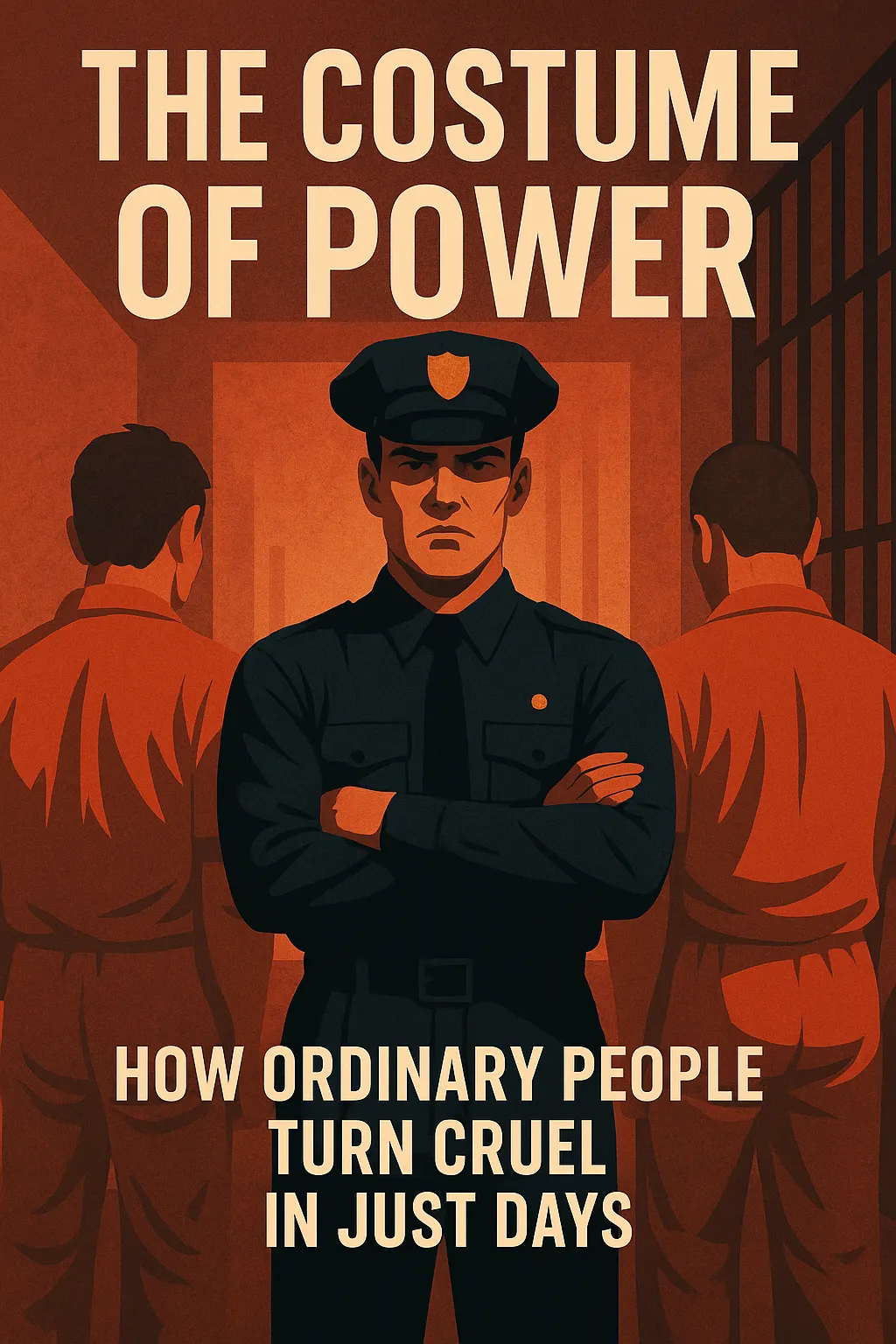
Have you ever wondered whether power changes people or simply reveals who they already are?
Most of us like to believe that we would never abuse authority or treat another person unfairly simply because we were given a position of power. We imagine that kindness, empathy, and morality are permanent parts of our character that remain unchanged regardless of the situation. It is comforting to believe that cruel people are fundamentally different from us and that ordinary individuals naturally choose compassion over control.
Psychology, however, offers a more complicated picture. Human behavior is shaped not only by personality but also by the environments we live in, the roles we are assigned, and the expectations placed upon us. Throughout history, researchers have tried to understand why seemingly ordinary people sometimes participate in acts they would never have imagined themselves capable of committing.
Few psychological studies have explored this question more famously than the Stanford Prison Experiment. Conducted in 1971 by psychologist Philip Zimbardo, the experiment became one of the most discussed and controversial studies in psychology. Although many experts now question its methods and conclusions, it continues to raise important questions about authority, conformity, and the influence of social roles on human behavior.
Table of Contents
The Stanford Prison Experiment
In the summer of 1971, psychologist Philip Zimbardo transformed the basement of Stanford University’s psychology building into a simulated prison. Twenty-four healthy male college students volunteered to participate after responding to newspaper advertisements. Each participant underwent screening to ensure they were physically and psychologically healthy before being randomly assigned to one of two groups: prisoners or guards.
The researchers wanted to understand how people would behave when placed inside a prison environment. The guards were given uniforms, mirrored sunglasses, whistles, and wooden batons to reinforce their authority, while the prisoners wore simple smocks and were identified by numbers instead of names. These details were designed to strengthen each participant’s assigned role and create a realistic prison atmosphere.
The study was originally planned to last two weeks. Instead, it was stopped after only six days because the situation had become increasingly distressing for many of the participants.
When Roles Began to Shape Behavior
During the experiment, some guards became increasingly authoritarian, enforcing strict rules and creating punishments that were never required by the researchers. Several prisoners became emotionally distressed, withdrawn, or anxious as they adapted to the prison environment. The emotional intensity of the simulation surprised both the participants and the research team.
Zimbardo argued that the situation itself influenced behavior more than individual personality traits. According to his interpretation, ordinary people could begin acting differently when immersed in powerful social roles and institutional settings.
The study quickly became famous because it appeared to demonstrate how authority and environment could shape human actions in dramatic ways.
A Study That Changed Psychology—and Sparked Debate
Although the Stanford Prison Experiment became one of the best-known studies in psychology textbooks, it has also become one of the field’s most criticized experiments.
Many psychologists argue that participants may have behaved the way they believed researchers expected them to behave. Others point to methodological weaknesses, ethical concerns, and questions about whether the findings can be generalized to real life. Historians and researchers have also noted evidence suggesting that some guards received guidance that may have influenced their behavior.
For these reasons, modern psychologists often treat the experiment as an important historical case study rather than definitive scientific proof that power alone transforms ordinary people into cruel individuals.
What Psychology Still Teaches Us About Power
Even though the Stanford Prison Experiment remains controversial, decades of psychological research support the broader idea that social environments influence human behavior. Studies on conformity, obedience, group dynamics, and organizational culture consistently show that people are affected by the expectations, norms, and authority structures around them.
This does not mean that people lose personal responsibility. Instead, it reminds us that decisions are often shaped by both individual character and the situations we encounter.
Understanding these influences helps explain why ethical leadership, accountability, transparency, and empathy are essential in schools, workplaces, governments, and communities.
Where We See These Lessons Today
The psychological questions raised by the Stanford Prison Experiment remain relevant today. They can be observed in workplaces where authority is abused, online communities where anonymity encourages harassment, institutions where people follow harmful practices without questioning them, and organizations where unethical behavior becomes normalized over time.
These situations remind us that healthy systems matter just as much as good intentions. Environments that encourage empathy, accountability, and critical thinking are far less likely to produce harmful behavior than environments built on fear, unquestioned authority, or dehumanization.
Final Thoughts
The Stanford Prison Experiment continues to fascinate people more than fifty years after it was conducted because it forces us to examine uncomfortable questions about ourselves. While its conclusions remain debated, the study serves as a powerful reminder that human behavior is influenced by both personal values and the environments we create.
Power does not automatically make people cruel, nor does authority erase personal responsibility. Instead, psychology suggests that character, accountability, empathy, and healthy institutions all play important roles in determining how people use the power they are given.
Perhaps the most valuable lesson is not that anyone can become cruel overnight, but that every society must build systems that encourage compassion, responsibility, and respect for human dignity. When power is balanced by accountability and empathy, it becomes a tool for leadership rather than domination.
Frequently Asked Questions
What was the Stanford Prison Experiment?
The Stanford Prison Experiment was a 1971 psychology study conducted by Philip Zimbardo to examine how people behave when assigned the roles of guards and prisoners in a simulated prison.
Why is the Stanford Prison Experiment controversial?
Many researchers have criticized the study for ethical concerns, methodological flaws, and questions about whether participants’ behavior was influenced by researcher expectations.
Did the experiment prove that power makes people cruel?
No. While the study suggested that situations influence behavior, modern psychologists consider its conclusions debated and emphasize that many factors—including personality, social norms, and accountability—affect human actions.
Why is the Stanford Prison Experiment still important?
Despite its criticisms, the experiment remains influential because it encourages discussion about authority, conformity, ethics, leadership, and the psychological impact of social roles.