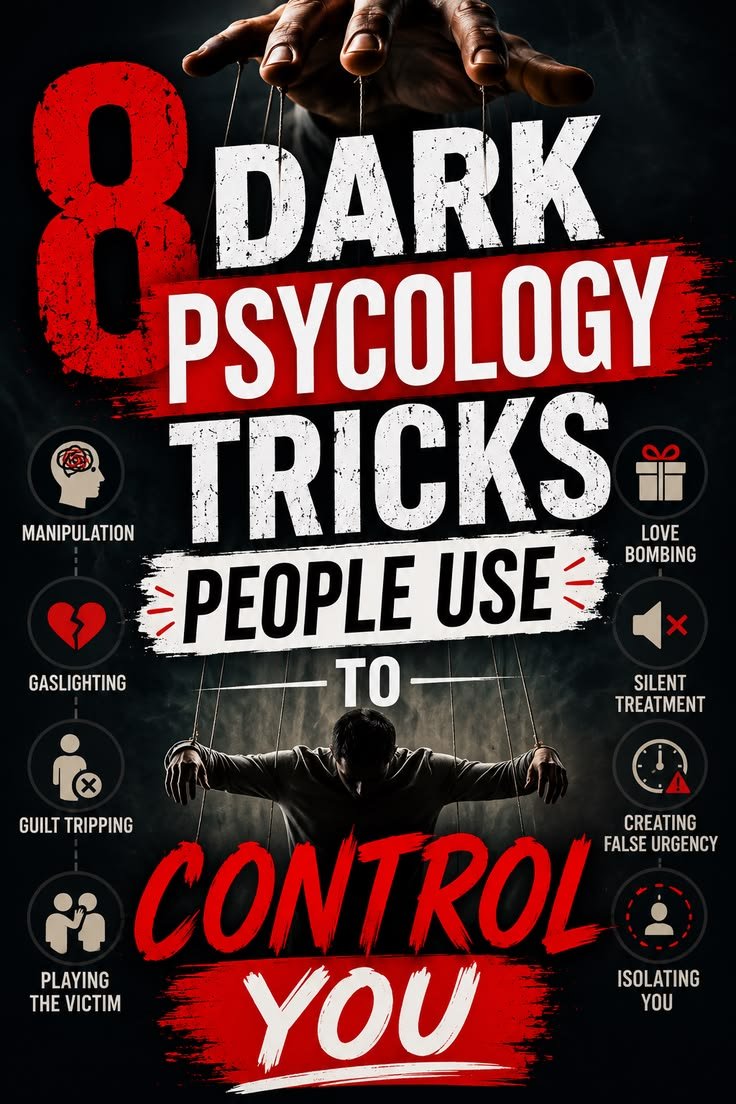
Human behavior is rarely as simple as it appears. Every day, people influence each other’s decisions through words, emotions, body language, and subtle psychological cues. Most of the time these interactions are harmless, but sometimes they are carefully designed to persuade, manipulate, or gain control. This hidden side of human influence is often referred to as dark psychology.
When people hear the term, they usually think of obvious manipulation techniques like gaslighting, guilt-tripping, or emotional blackmail. However, psychology contains many lesser-known principles that can quietly shape opinions, decisions, and relationships without people even realizing it.
Learning these techniques isn’t about becoming manipulative. It’s about understanding how influence works so you can recognize it when others use it, protect yourself from psychological manipulation, and make more informed decisions. The more you understand human behavior, the less likely you are to become its victim.
Below are fifteen fascinating psychological tactics that demonstrate just how powerful the human mind can be.
Table of Contents
- 1 1. The Illusory Truth Effect
- 2 2. The Ben Franklin Effect
- 3 3. The Foot-in-the-Door Technique
- 4 4. The Zeigarnik Effect
- 5 5. The Pygmalion Effect
- 6 6. Reverse Psychology
- 7 7. The Silent Treatment
- 8 8. Anchoring Bias
- 9 9. Mirroring
- 10 10. The Scarcity Principle
- 11 11. The Door-in-the-Face Technique
- 12 12. Intermittent Reinforcement
- 13 13. Emotional Contagion
- 14 14. The Decoy Effect
- 15 15. Strategic Self-Deprecation
- 16 Why These Tactics Matter
- 17 Protecting Yourself from Psychological Manipulation
- 18 Final Thoughts
- 19 Frequently Asked Questions
1. The Illusory Truth Effect
One of the most surprising discoveries in psychology is that repetition creates belief. The more often people hear a statement, the more familiar it becomes, and familiarity is frequently mistaken for truth.
This is why advertisers repeat slogans, politicians repeat talking points, and misinformation spreads so easily online. Even when people know a claim lacks evidence, repeated exposure can slowly make it feel believable.
The best defense is to evaluate information based on evidence rather than familiarity.
2. The Ben Franklin Effect
It seems logical that we do favors for people we already like. Surprisingly, psychology often works in the opposite direction.
When someone asks us for a reasonable favor and we agree, our brain tries to justify why we helped them. Instead of concluding that we simply did a favor, we often convince ourselves that we must actually like the person.
This cognitive adjustment can strengthen relationships, but skilled manipulators sometimes use it to build trust surprisingly quickly.
3. The Foot-in-the-Door Technique
People naturally prefer consistency. Once we agree to a small request, we’re much more likely to agree to a larger request later because saying no would feel inconsistent with our earlier decision.
Salespeople, fundraisers, and negotiators frequently use this strategy by beginning with a simple commitment before introducing a much bigger request.
Small agreements often become stepping stones toward much larger ones.
4. The Zeigarnik Effect
Have you ever found yourself thinking repeatedly about an unfinished conversation or incomplete task?
Psychologists call this the Zeigarnik Effect. Our brains naturally remember unfinished experiences more vividly than completed ones.
Manipulative people sometimes exploit this by ending conversations abruptly, leaving questions unanswered, or creating emotional uncertainty that keeps them occupying your thoughts long after the interaction ends.
5. The Pygmalion Effect
Expectations can become self-fulfilling prophecies.
When teachers, managers, coaches, or parents genuinely believe someone will succeed, that person often performs better because they unconsciously rise to meet those expectations.
Positive expectations inspire confidence, while consistently low expectations can limit growth.
This powerful psychological effect reminds us that the beliefs others hold about us can quietly influence our own behavior.
6. Reverse Psychology
Human beings value autonomy. When people feel their freedom is being restricted, they often become motivated to prove their independence.
Reverse psychology takes advantage of this tendency by suggesting someone should not do something, making them more likely to choose that exact action.
Although it doesn’t work on everyone, it can be remarkably effective with highly independent or stubborn personalities.
7. The Silent Treatment
Silence can communicate far more than words.
Ignoring someone after conflict creates uncertainty, emotional discomfort, and anxiety. Many people become eager to restore communication, even if it means apologizing for something they didn’t do.
Healthy relationships use communication to resolve disagreements. Manipulative relationships often use silence as a form of emotional control.
8. Anchoring Bias
The first number people hear strongly influences every judgment that follows.
If a salesperson begins negotiations with an extremely high price, every later offer feels more reasonable by comparison, even if it’s still expensive.
This psychological anchor affects everything from salary negotiations to real estate prices and online shopping.
Understanding anchoring helps people evaluate offers more objectively instead of relying on arbitrary starting points.
9. Mirroring
People naturally trust those who seem similar to themselves.
Subtly copying another person’s posture, speaking style, facial expressions, or pace of conversation creates an unconscious sense of familiarity and comfort.
When used genuinely, mirroring builds rapport and empathy.
When used strategically, it can make someone feel understood while lowering their psychological defenses.
10. The Scarcity Principle
People place greater value on things that appear rare or difficult to obtain.
Limited-time offers, exclusive memberships, low-stock notifications, and invitation-only communities all rely on this psychological bias.
Scarcity increases urgency because our brains fear losing opportunities more than missing ordinary ones.
The question to ask is whether something is truly valuable or simply presented as scarce.
11. The Door-in-the-Face Technique
This strategy works by starting with an unreasonable request that is likely to be rejected.
Immediately afterward, the manipulator presents a much smaller request that suddenly seems reasonable by comparison.
Because the second request feels like a compromise, many people feel obligated to accept it.
The tactic exploits our natural tendency toward reciprocity and fairness.
12. Intermittent Reinforcement
Few psychological principles are as powerful as unpredictable rewards.
When rewards arrive randomly instead of consistently, our brains become even more motivated to continue seeking them.
Casinos rely on this principle. Social media notifications use it. Unfortunately, many unhealthy relationships also operate this way by alternating affection with emotional distance.
Uncertainty keeps people emotionally invested far longer than consistency.
13. Emotional Contagion
Emotions spread between people almost like viruses.
One person’s excitement can energize an entire team. One person’s anxiety can quickly fill a room with tension.
Manipulative individuals understand that controlling emotional atmosphere often gives them more influence than controlling facts.
Learning to recognize emotional contagion helps you distinguish between your own emotions and those absorbed from others.
14. The Decoy Effect
Sometimes people don’t influence your choice by improving one option—they influence it by adding another option.
Marketers frequently introduce a deliberately unattractive third choice to make their preferred option seem like the obvious decision.
Without changing the actual value of the products, they quietly change how your brain compares them.
The decision feels independent, but the comparison has already been engineered.
15. Strategic Self-Deprecation
Not every display of humility is genuine.
Some people intentionally present themselves as insecure, vulnerable, or harmless to lower suspicion and build trust.
Once emotional defenses disappear, they become much more influential.
True humility seeks connection. Strategic humility seeks advantage.
Understanding the difference requires paying attention to consistent behavior rather than isolated words.
Why These Tactics Matter
Dark psychology is often misunderstood. Most psychological principles are neither good nor bad on their own. They simply describe predictable patterns in human thinking and behavior.
A therapist may use psychological influence to help a patient heal. A teacher may use it to motivate students. A marketer may use it to sell products. A manipulative person may use exactly the same principles to gain control.
The psychology itself is neutral.
The intention behind it makes all the difference.
Protecting Yourself from Psychological Manipulation
The strongest defense against manipulation is awareness. When you understand how influence works, you become less likely to make automatic decisions driven by emotion or unconscious bias.
Before agreeing to important requests, ask yourself whether you’re responding because it genuinely aligns with your values or because someone carefully shaped the situation to encourage a particular response.
Critical thinking, emotional awareness, and healthy boundaries remain the most effective protection against manipulation.
Final Thoughts
Human psychology is filled with fascinating shortcuts, biases, and unconscious tendencies that influence our everyday decisions. Most of us experience these effects without ever realizing they are happening.
The fifteen techniques discussed here demonstrate just how easily perception, emotion, and behavior can be guided under the right circumstances. They are not inherently dangerous, but in the wrong hands they can become remarkably powerful tools of persuasion and control.
The goal isn’t to fear psychology.
The goal is to understand it.
Because once you recognize the hidden forces shaping human behavior, you become far better equipped to think independently, protect your own decisions, and navigate relationships with greater confidence and awareness.
Frequently Asked Questions
What is dark psychology?
Dark psychology refers to the study of manipulation, persuasion, deception, and influence techniques used to shape another person’s thoughts, emotions, or behavior.
Are these psychological tactics always manipulative?
No. Many psychological principles are used ethically in education, leadership, therapy, and communication. They become manipulative when they are used to exploit or control others.
How can I recognize psychological manipulation?
Pay attention to repeated pressure, emotional discomfort, artificial urgency, guilt, inconsistent rewards, and situations where someone seems to influence your decisions without obvious force.
Can learning dark psychology protect me?
Yes. Understanding these techniques helps you recognize manipulation, strengthen critical thinking, and make more independent decisions.