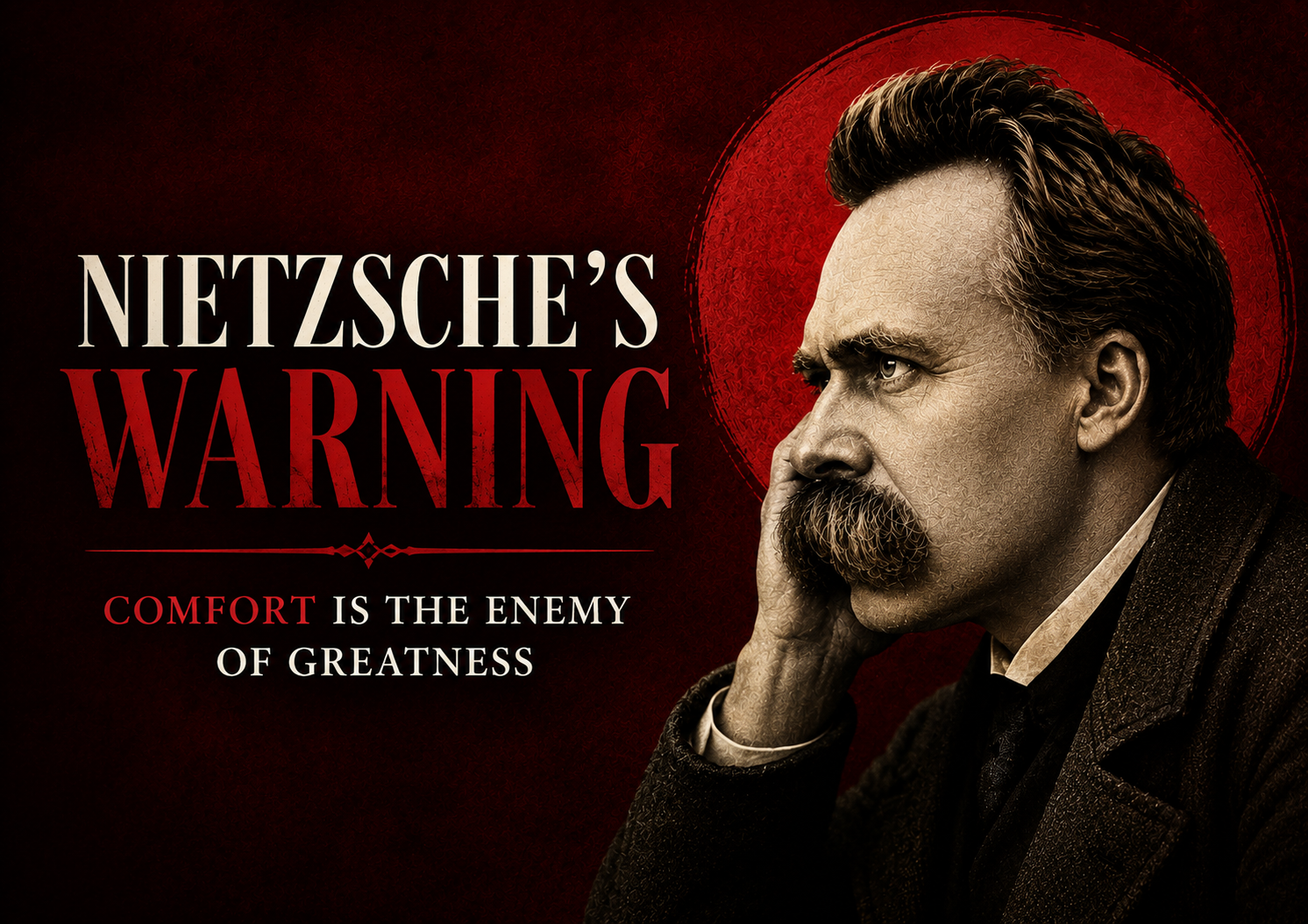
Nietzsche’s Warning | Comfort Is the Enemy of Greatness
“That which does not kill us makes us stronger.” — Friedrich Nietzsche
Comfort is the enemy of greatness. Nietzsche’s philosophy of self-overcoming and the will to power.
Have you ever felt as though you are living a life that isn’t truly yours? That despite everything appearing to be in order, something inside remains broken, suffocated, or dormant. Perhaps no one else can see it. Perhaps you cannot even explain it clearly yourself. Yet you feel it. A quiet anguish disguised as boredom, apathy, or fatigue. And that is where the problem begins.
Most of us are taught to run from discomfort. We are told that a good life is a peaceful life, that suffering is a sign of failure, and that pain is something to be avoided whenever possible. Nietzsche believed this was one of the most seductive lies modern people tell themselves.
According to him, the true driving force of existence is not the pursuit of comfort but the drive toward overcoming. He called this force the will to power.
This idea is often misunderstood. Nietzsche was not talking about domination over others. He was talking about mastery over oneself. The ability to transform defeat into strength, setbacks into growth, and suffering into a tool for transformation.
If you feel stagnant, lost, or trapped in a smaller version of yourself, perhaps that feeling is not evidence that something is wrong with you. Perhaps it is evidence that you have been living against your own nature.
Nietzsche believed that life does not seek comfort. It seeks intensity. It seeks growth. It seeks confrontation. It calls us toward the unknown, demanding that we step beyond the boundaries of who we have been and discover who we might become. For those willing to answer that call, life becomes more than survival. It becomes an act of creation.
This essay is for those who sense that there is something within them waiting to awaken. For those who have already begun to suspect that the conventional path may lead to safety but rarely leads to greatness.
To understand Nietzsche’s philosophy is to enter dangerous territory. Once you grasp the meaning of the will to power, ignorance is no longer comfortable. Passivity becomes difficult to tolerate. You begin to see the subtle ways society encourages conformity, weakness, and dependence. Yet if you have the courage to continue, this realization can become the beginning of a profound transformation.
Nietzsche famously wrote that what does not kill us makes us stronger. The question is not whether suffering exists. The question is whether we will use it. Will we remain trapped in survival, or will we begin the difficult work of truly living?
The Hidden Force Driving Human Growth
Nietzsche did not write to comfort his readers. He wrote to awaken them. His words function like hammers, breaking apart assumptions that most people accept without question.
One of the most important illusions he challenged was the belief that human beings primarily seek happiness. Nietzsche believed that beneath our desires lies something deeper than comfort or pleasure. Human beings seek growth. They seek expansion. They seek the experience of becoming more than they currently are.
This underlying impulse is what Nietzsche called the will to power. It is not a political concept or a desire for domination. It is a living force that pushes individuals toward self-expression, self-mastery, and self-overcoming. It is the impulse that urges a person to confront fear, to develop their abilities, and to transcend their limitations. It is the force that refuses to remain stagnant.
The will to power is not concerned with stability. It seeks expansion. It pushes life beyond itself. Every meaningful act of courage, every decision that requires growth, every refusal to remain trapped in an old identity reflects this force at work. It emerges whenever a person stops asking for permission to exist and begins taking responsibility for shaping their own life.
Around this central idea orbit several of Nietzsche’s most important concepts.
The revaluation of values is the process of questioning inherited beliefs and moral systems. Nietzsche believed that many traditional values encouraged submission, guilt, and conformity. He challenged individuals to examine those values critically and create new values rooted in strength, vitality, and affirmation of life.
God is dead was not a simple theological statement. Nietzsche was describing the collapse of absolute certainties that had previously given people a sense of meaning and direction. If those certainties no longer guide us, then responsibility falls upon each individual to create meaning for themselves.
Eternal recurrence is the thought experiment that asks whether you would willingly live your current life again and again for eternity. Every success, every failure, every joy, every heartbreak. The question is deeply unsettling because it forces us to confront the authenticity of the lives we are living. If the answer is no, then perhaps something must change.
The Overman is Nietzsche’s vision of a person who rises beyond herd mentality and becomes the creator of their own values. The Overman does not wait for meaning to be given. He creates it. He does not simply adapt to the world. He actively shapes himself and, through that process, shapes the world around him.
All of these ideas emerge from the same source. The demand to become more than you are. Not because society expects it, but because life itself seems to call for it.
Yet the path of growth raises a difficult question. What does life demand from those who genuinely wish to evolve? The answer leads directly into one of Nietzsche’s most challenging insights: the role of suffering in human transformation.
Why Pain Is Not the Enemy
If growth is the goal, then suffering becomes unavoidable.
Modern culture often treats pain as a problem to be eliminated. We are encouraged to seek comfort, distraction, and constant emotional relief. Nietzsche viewed this attitude with deep suspicion. He believed that suffering is not merely an unfortunate aspect of existence. It is one of the primary conditions through which transformation occurs.
This belief was not abstract for him. Nietzsche endured chronic illness, loneliness, and widespread misunderstanding during his lifetime. Yet rather than viewing suffering as evidence that life had failed him, he treated it as a force capable of refining character and deepening insight. He came to understand something that many people spend their entire lives avoiding: pain can become a source of strength.
“You must have chaos within you to give birth to a dancing star.”
This is not poetic decoration. It is a profound observation about human development. Genuine strength often emerges from rupture. Courage emerges from fear. Clarity emerges from confusion. Transformation emerges from crisis.
Consider the moments that have changed you most deeply. The loss that forced you to rebuild. The failure that revealed a hidden weakness. The heartbreak that taught you something essential about yourself. In many cases, growth did not occur despite suffering. It occurred because of it.
For Nietzsche, suffering becomes the battlefield upon which the will to power reveals itself. Anyone can appear strong when circumstances are favorable. Character is tested when life becomes difficult. When certainty disappears. When comfort is removed. When old identities begin to collapse.
This is precisely why so many people avoid the process. Growth requires the death of familiar versions of ourselves. It demands that we abandon comfortable illusions. It asks us to confront weaknesses we would rather ignore. Yet all untransformed suffering eventually repeats itself. The pain we refuse to face returns in different forms until we learn what it has come to teach.
Nietzsche invites us to approach suffering differently. Not as an enemy to be escaped, but as material to be transformed.
The question is no longer how to avoid pain. The question becomes what this pain can teach us about who we are capable of becoming.
That shift changes everything.
The Invisible Prison We Build for Ourselves
Be honest. How many times have you felt that you could be more than you are, yet some invisible force keeps pulling you back into the same routines, the same fears, and the same habits that shrink your possibilities?
How many times have you felt a genuine desire for change, a moment of clarity that revealed a different future, only to find yourself returning to the same patterns a few days later?
Nietzsche would argue that this experience is far more common than most people realize. The tragedy is not simply that people remain trapped. The tragedy is that many never recognize the prison they inhabit.
Nietzsche called this condition decadence, a gradual weakening of life from within. It is not always visible from the outside. A person may appear successful, productive, and socially integrated while feeling inwardly exhausted and disconnected from themselves. They may have a career, relationships, ambitions, and routines, yet still experience a profound sense of emptiness. This is because functioning is not the same as living. Existence becomes hollow whenever growth is replaced by mere maintenance.
According to Nietzsche, many people spend their lives adapting rather than becoming. They accept inherited roles, inherited values, and inherited expectations because doing so feels safe. They learn to avoid conflict, avoid discomfort, and avoid risk. They learn how to fit in. What they rarely learn is how to become themselves.
Over time, this process creates a subtle form of self-betrayal. The individual slowly abandons their deepest possibilities in exchange for approval and stability.
The modern world often celebrates this kind of adaptation. We are encouraged to be agreeable, predictable, and manageable. We are taught to avoid upsetting the social order. Yet Nietzsche believed that beneath this apparent peace lies a dangerous form of spiritual stagnation. A person who spends their life avoiding confrontation eventually loses contact with the very forces that make growth possible. Safety becomes a cage. Comfort becomes a sedative.
This is why Nietzsche had little patience for passive existence. He believed that every individual contains possibilities far greater than they realize, yet those possibilities are constantly sabotaged by fear, excuses, and inherited beliefs. Every time we remain silent when we should speak, every time we choose comfort over necessity, and every time we settle for less than we know we are capable of, we reinforce the prison walls around us. The tragedy is not failure. The tragedy is never truly attempting to become what we might have been.
One of Nietzsche’s most uncomfortable insights is that liberation cannot be outsourced. There is no savior waiting to arrive. No system, ideology, teacher, or institution can perform the work of transformation on our behalf. The responsibility belongs entirely to us.
Freedom begins when we stop waiting for external permission and start confronting the stories we tell ourselves about who we are. Most of those stories were inherited. Many of them are false. Yet we cling to them because they feel familiar.
The prison, then, is not made of visible walls. It is made of assumptions, fears, and habits that have become so familiar we mistake them for reality. Breaking free requires more than motivation. It requires honesty. It requires the willingness to examine every excuse, every self-imposed limitation, and every belief that keeps us smaller than we could be.
For Nietzsche, this confrontation is not optional. It is the beginning of self-overcoming.
The Hardest Victory Is the One Within
Most people spend their lives trying to conquer the external world. They pursue status, recognition, wealth, influence, and admiration. They compete for attention and validation, believing that success in the eyes of others will finally provide a sense of worth. Nietzsche considered this pursuit deeply misguided. External victories may be impressive, but they are insignificant compared to the far more difficult task of mastering oneself.
True power, in Nietzsche’s view, has little to do with defeating others. It begins with the ability to confront one’s own weaknesses. This is a far more demanding challenge because the enemy is not outside us. It is within us. It appears as procrastination, fear, resentment, self-deception, laziness, and the countless habits that keep us trapped in familiar versions of ourselves.
Self-overcoming is not a single event. It is a lifelong process. Nietzsche saw human beings not as fixed identities but as unfinished possibilities. We are not static creatures. We are becoming. Every day presents a choice between remaining who we are and moving toward who we might become. Growth occurs whenever we choose transformation over stagnation.
Yet transformation is painful because it requires the death of old identities. The version of yourself that learned how to survive may not be the version capable of thriving. The habits that once protected you may now restrict you. The beliefs that once provided comfort may now prevent growth. To become someone new, something old must be surrendered.
Nietzsche understood that this process rarely unfolds in a straight line. Growth is chaotic. It involves progress and setbacks, confidence and doubt, victories and failures. There are moments when transformation feels exhilarating and moments when it feels unbearable. But this instability is not evidence that something has gone wrong. It is evidence that change is taking place.
The deepest form of courage is not the courage to defeat an opponent. It is the courage to face oneself without illusion. To look honestly at the patterns that hold us back. To admit where we have compromised, where we have hidden, and where we have settled.
Self-overcoming begins with this brutal honesty. It begins when a person becomes unwilling to tolerate their own excuses.
This is where Nietzsche introduces one of his most powerful ideas: the Overman. The Overman is not a superior species or a political ideal. He is a symbol of what becomes possible when a person refuses to remain confined by inherited limitations. The Overman creates values rather than merely accepting them. He shapes his life deliberately rather than passively drifting through it. He chooses authenticity over approval, creation over conformity, and growth over comfort.
Reaching this state requires sacrifice. It often requires walking alone. The individual who commits themselves to self-overcoming inevitably begins to diverge from the expectations of the crowd. They stop living according to scripts written by others. They begin creating their own.
The true measure of power, then, is not dominance. It is the capacity for renewal. The ability to shed old identities, survive periods of uncertainty, and emerge stronger than before. Every meaningful transformation requires a kind of death. Yet it is only through these symbolic deaths that new possibilities become visible.
For Nietzsche, greatness is not something discovered. It is something forged. And the forge is rarely comfortable.
Why Modern Life Rewards Weakness
If Nietzsche were alive today, he would likely recognize a strange contradiction at the heart of modern life. We speak endlessly about freedom, individuality, and self-expression, yet much of contemporary culture quietly rewards conformity. We celebrate authenticity in theory while often punishing it in practice. We encourage people to think for themselves, but we surround them with systems designed to keep them distracted, dependent, and comfortable.
The modern world offers countless forms of entertainment, convenience, and instant gratification. None of these things are inherently harmful. The danger emerges when comfort becomes the highest value. When every inconvenience is treated as a problem to be eliminated, every discomfort as something to be escaped, and every challenge as something unnecessary. In such an environment, the will to power gradually weakens. The desire for growth is replaced by the desire for ease.
Nietzsche believed that human beings become strongest when they are forced to confront resistance. Yet much of modern culture encourages the opposite. We are surrounded by distractions that prevent reflection, pleasures that prevent discipline, and endless sources of validation that prevent genuine self-examination. Instead of confronting emptiness, many people learn how to distract themselves from it. Instead of questioning their lives, they learn how to remain comfortably occupied.
This is why Nietzsche’s philosophy remains unsettling. It refuses to flatter us. It refuses to tell us that comfort is enough. It insists that growth requires friction. It insists that freedom demands responsibility. Most importantly, it insists that a meaningful life cannot be built upon avoidance.
To live according to the will to power in the modern world means accepting that you may often feel out of step with the values around you. It means refusing to define yourself through popularity, approval, or convenience. It means choosing the discomfort of truth over the comfort of illusion. It means developing the strength to continue becoming yourself even when that process is misunderstood by others.
Such a path is not glamorous. It often involves uncertainty, criticism, and loneliness. There will be moments when growth feels far more difficult than conformity. Yet Nietzsche believed that the alternative is far worse. A life spent avoiding discomfort eventually becomes a life spent avoiding oneself.
Living the will to power means asking a different set of questions. Instead of asking what is easiest, you begin asking what is necessary. Instead of asking what will earn approval, you ask what will deepen your character. Instead of asking how to avoid failure, you ask how to transform failure into strength. Slowly, your attention shifts from managing appearances to shaping your soul.
This is not merely a philosophical exercise. It is a way of living. A commitment to growth even when growth hurts. A refusal to settle for a diminished version of yourself. A willingness to sacrifice temporary comfort for long-term transformation.
The world may reward conformity, but greatness has rarely emerged from conformity. It emerges from individuals willing to risk misunderstanding in pursuit of something more authentic. Nietzsche understood this. He knew that every meaningful act of creation begins with the courage to stand apart from the crowd.
Will You Choose Comfort or Transformation?
At the center of Nietzsche’s philosophy lies a question that cannot be avoided indefinitely: What kind of life do you want to live?
Do you want a life organized around comfort, predictability, and safety? Or do you want a life organized around growth, transformation, and the continual challenge of becoming more than you currently are?
The difficult truth is that these paths often move in different directions.
Comfort offers security. It asks very little of you. It encourages you to remain where you are, to avoid risk, and to seek stability above all else. There is a certain peace in that choice. Yet it is often a fragile peace, one that comes at the cost of unrealized potential. Many people spend years protecting themselves from discomfort only to discover that they have also protected themselves from growth.
Transformation demands something different. It requires discipline, courage, and the willingness to abandon familiar versions of yourself. It asks you to question inherited assumptions, challenge old habits, and step repeatedly into uncertainty. It offers no guarantees. What it offers instead is the possibility of becoming.
For Nietzsche, meaning is not discovered in comfort. Meaning emerges through overcoming. It emerges when obstacles become opportunities for growth, when suffering becomes a source of wisdom, and when individuals stop measuring themselves according to external standards and begin shaping themselves according to their highest possibilities.
This is why Nietzsche’s philosophy remains so powerful. It refuses to reduce life to pleasure or happiness alone. It asks something more demanding. It asks whether you are willing to become the author of your own existence.
Every person eventually faces this decision. Some choose familiarity. Others choose growth. Some spend their lives preserving who they have been. Others devote themselves to becoming who they might be.
The choice is deeply personal, and no one can make it for you.
Yet if something in this essay stirred a sense of restlessness, if some part of you recognized itself in these ideas, perhaps the will to power is already at work. Perhaps the dissatisfaction you feel is not a flaw but a signal. A reminder that there is still more within you waiting to emerge.
Nietzsche’s challenge remains as relevant today as it was more than a century ago. Do not ask whether life will be comfortable. Ask whether it will be meaningful. Do not ask how to avoid struggle. Ask how struggle might transform you. Do not ask what the world expects of you. Ask what you are capable of becoming.
In the end, greatness is rarely the result of talent alone. It is the result of choosing growth when comfort would be easier. It is the result of embracing transformation when stagnation would feel safer. It is the result of repeatedly answering life’s deepest challenge with courage rather than avoidance.
The question remains the same now as it did in Nietzsche’s time: Will you choose comfort, or will you choose transformation?
A Question for You
What is one belief, habit, fear, or limitation that you know must be left behind if you are to become the person you are capable of becoming?
I’d love to hear your thoughts in the comments.
If this essay challenged the way you think about suffering, growth, and human potential, consider supporting my work with a coffee. Your support helps me continue exploring the ideas that shape how we live, think, and become.
I write these essays alone, late at night, because I genuinely believe ideas can change how we live. If this one moved you even slightly, a coffee would mean the world to me. ☕ Buy Me a Coffee