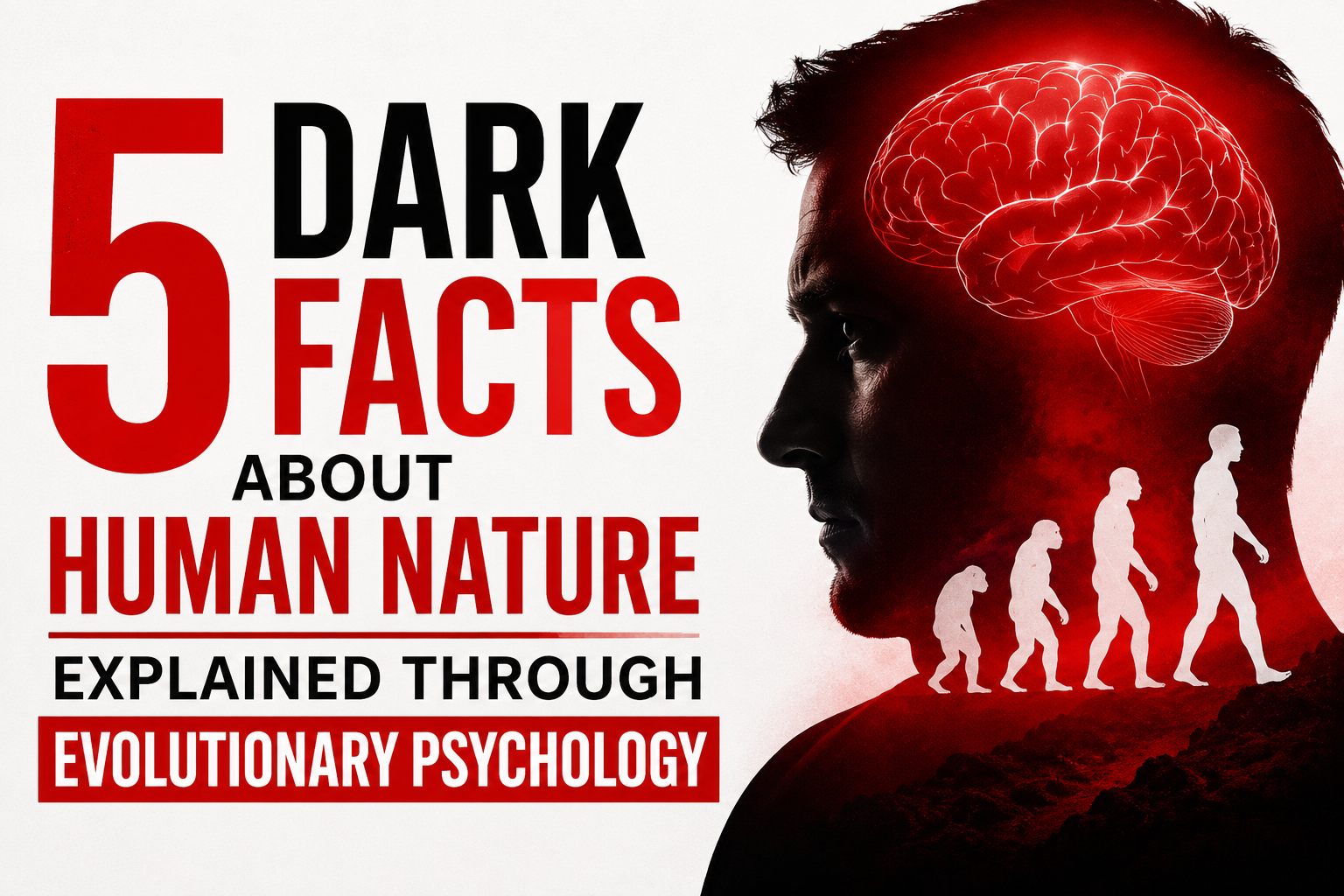
Human nature has a darker side that motivational quotes and feel-good advice often leave out. We like to think of ourselves as rational, compassionate, and civilized, yet some of our strongest instincts were shaped in environments where survival depended on competition, loyalty, status, reproduction, and protection from outsiders. Evolutionary psychology offers one way of examining these uncomfortable patterns by asking how certain behaviors and psychological tendencies may have developed over thousands of generations.
This does not mean that every unpleasant human behavior is inevitable or that evolution excuses cruelty. Quite the opposite. Understanding where certain instincts may come from can help us recognize them before they control our decisions. Jealousy can become destructive, tribal loyalty can turn into hatred, and the desire for status can encourage dangerous behavior. The important question is not whether these instincts exist, but whether we are capable of understanding and managing them.
Here are five unsettling facts about human behavior that become particularly interesting when viewed through the lens of evolutionary psychology.
Table of Contents
- 1 1. Infidelity and Homicide Can Be Connected Through Jealousy
- 2 2. The “Cinderella Effect” Raises Difficult Questions About Step-Parenting
- 3 3. Cheating Is an Ancient Problem, and Our Minds May Be Designed to Detect It
- 4 4. “Us Versus Them” Thinking Is Easier Than We Like to Admit
- 5 5. Young Men Are More Likely to Take Dangerous Risks
- 6 The Dark Side of Human Nature Is Not Our Destiny
- 7 Understanding Our Instincts Gives Us More Freedom
- 8 Final Thoughts
1. Infidelity and Homicide Can Be Connected Through Jealousy
When people think about homicide, they often imagine motives such as greed, revenge, anger, or criminal intent. Yet researchers have also examined the relationship between intimate relationships, jealousy, sexual rivalry, and violence. Research by evolutionary psychologists Martin Daly and Margo Wilson explored how jealousy and suspected sexual infidelity can contribute to serious interpersonal violence.
From an evolutionary perspective, researchers have proposed that sexual betrayal could have carried significant reproductive consequences for ancestral humans. For a man, uncertainty about paternity could potentially mean investing resources in a child who was not genetically related to him. For women, a partner’s sexual infidelity could potentially threaten emotional commitment, resources, protection, or long-term investment.
These evolutionary pressures may help explain why jealousy can become such an intense human emotion. But understanding a possible evolutionary origin does not make violence acceptable. Jealousy is an emotion; violence is a choice. Modern societies have moral, legal, and social systems specifically designed to prevent people from turning powerful emotions into destructive actions.
The deeper lesson is that some of our most dangerous reactions can emerge from emotions that initially developed around attachment, loss, competition, and fear.
2. The “Cinderella Effect” Raises Difficult Questions About Step-Parenting
The idea of the “Cinderella Effect” became widely known through research by Daly and Wilson examining whether children living with stepparents face different risks of abuse than children living with two biological parents. Their work raised difficult questions about parental investment and the possible role of evolutionary psychology in understanding differences in caregiving.
One proposed explanation is that biological parents have a direct genetic relationship with their children, while stepparents do not necessarily share that genetic connection. From an evolutionary perspective, this difference may influence patterns of investment and caregiving under certain circumstances.
However, this subject requires an important degree of caution. Stepparents are not inherently less loving, less protective, or less committed than biological parents. Millions of stepfamilies contain deep affection, sacrifice, and genuine parental bonds. Human relationships cannot be reduced to genetics alone.
The real value of this research is that it encourages us to examine the complicated forces that can influence caregiving and family relationships. Biology may shape certain tendencies, but culture, morality, attachment, personal experience, and conscious choices can profoundly change how people behave.
3. Cheating Is an Ancient Problem, and Our Minds May Be Designed to Detect It
Human cooperation depends heavily on trust. Whether people are sharing food, exchanging resources, working together, or protecting one another, cooperation becomes difficult when someone consistently takes without contributing.
This may help explain why humans appear to be highly sensitive to cheating and unfairness. Researchers Leda Cosmides and John Tooby proposed that the human mind contains specialized cognitive mechanisms that help us identify individuals who violate social exchange rules. In other words, our brains may be particularly attentive when someone receives a benefit without fulfilling the expected obligation.
Think about how quickly people notice unfairness. If two coworkers are supposed to contribute equally to a project but one takes credit while doing almost nothing, the imbalance can trigger immediate anger. If someone accepts help repeatedly but never offers help in return, trust begins to disappear.
These reactions are not necessarily signs of irrationality. Cooperation has always required some method of identifying individuals who exploit the system. The modern world may be dramatically different from ancestral environments, but the psychological sensitivity to fairness and betrayal remains remarkably powerful.
The interesting part is that our ability to detect cheating can be useful, but it can also become excessive. Sometimes we interpret ordinary mistakes, misunderstandings, or differences in behavior as deliberate betrayal. The same psychological system that protects cooperation can therefore create unnecessary suspicion when it is triggered too easily.
4. “Us Versus Them” Thinking Is Easier Than We Like to Admit
Humans have an extraordinary ability to form groups. We identify ourselves through families, communities, religions, political movements, sports teams, professions, cultures, and countless other social identities. Belonging gives people connection, meaning, and security.
But the same instinct that creates belonging can also create division.
Social psychology has repeatedly demonstrated how easily people can categorize themselves into groups and begin favoring members of their own group. Henri Tajfel’s work on social identity helped show how even relatively meaningless group distinctions can influence how people perceive themselves and others.
This tendency may have offered advantages in environments where cooperation within a group was essential for survival. A person who knew who could be trusted, who belonged to their community, and who might represent a threat could respond more quickly to danger.
The modern world, however, presents a serious problem for this ancient tendency. We no longer live exclusively in small communities surrounded by unfamiliar rival groups. We live in interconnected societies where people with different beliefs, backgrounds, and identities interact constantly.
Yet our brains can still divide the world into “us” and “them.”
This can be seen in political polarization, online arguments, nationalism, sports rivalries, workplace conflicts, and social media communities. Once another group becomes psychologically categorized as the enemy, it becomes easier to dismiss its members, exaggerate their flaws, and excuse behavior from our own side that we would condemn in someone else.
The danger is not group identity itself. Belonging is an important part of human life. The danger begins when loyalty becomes so powerful that it destroys our ability to recognize the humanity of people outside our group.
5. Young Men Are More Likely to Take Dangerous Risks
Across many societies, young men have historically experienced higher rates of death from risky behavior than young women. This pattern appears in areas such as dangerous driving, physical violence, accidents, and other forms of high-risk behavior.
Evolutionary psychologists have proposed that some of this behavior may be connected to competition for status, social position, resources, and potential mates. In environments where status could influence access to opportunities and relationships, taking risks might sometimes have offered potential rewards.
But there is an obvious cost.
A willingness to take risks can sometimes produce achievement, courage, exploration, and innovation. Taken too far, however, the same tendency can become reckless behavior with devastating consequences.
A young person may drive too fast because they want to impress friends. Someone may enter a dangerous confrontation because backing down feels like losing status. Another person may take unnecessary financial or physical risks because the potential reward feels more important than the possibility of failure.
Evolution may help explain why these tendencies exist, but it does not determine what an individual must do. Human beings can recognize their impulses, evaluate consequences, and choose differently.
That ability to pause between instinct and action may be one of the most important advantages of human intelligence.
The Dark Side of Human Nature Is Not Our Destiny
These five examples can make human nature seem bleak, but evolutionary psychology should not be used as a declaration that people are naturally cruel or selfish. Human beings have also evolved extraordinary capacities for cooperation, empathy, attachment, sacrifice, communication, and social learning.
The same species capable of jealousy is capable of devotion. The same mind that creates tribal divisions can build friendships across cultures. The same desire for status that encourages dangerous competition can motivate people to accomplish extraordinary things. The same sensitivity to cheating that creates suspicion also makes fairness and cooperation possible.
This is why the distinction between “natural” and “good” matters so much.
Something can have deep evolutionary roots without being morally acceptable. Anger may be natural, but violence is not automatically justified. Jealousy may be natural, but controlling another person is not. Tribal loyalty may be natural, but hatred toward outsiders does not become acceptable simply because humans have a tendency toward group formation.
Evolution explains pressures and tendencies. It does not write our moral rules.
Understanding Our Instincts Gives Us More Freedom
Perhaps the most valuable lesson of evolutionary psychology is not that humans are secretly dark. It is that many of our reactions have histories.
When jealousy suddenly becomes overwhelming, we can recognize that the emotion may be connected to attachment, insecurity, and competition. When we feel intense hostility toward an opposing group, we can question whether our brain is turning social differences into an exaggerated threat. When we feel pressured to prove ourselves through dangerous behavior, we can step back and ask whether the reward is actually worth the risk.
Awareness creates distance between an impulse and an action.
We cannot simply delete millions of years of psychological evolution, but we can learn to understand the instincts that evolution left behind. Civilization itself is, in many ways, an attempt to create systems that help us manage those instincts rather than simply obey them.
Final Thoughts
Human nature contains both beauty and darkness. We are capable of extraordinary kindness, but we are also capable of jealousy, deception, tribalism, aggression, and reckless behavior. Evolutionary psychology gives us a framework for exploring why some of these tendencies may exist, but understanding them should never become an excuse for harmful behavior.
The most important lesson is that our instincts are not our destiny.
We may inherit tendencies, but we still have the ability to reflect, question, learn, and choose. The more honestly we understand the darker corners of human psychology, the better equipped we become to recognize them in ourselves and others.
Perhaps the real purpose of understanding our evolutionary past is not to justify the worst parts of human nature, but to become conscious enough to rise above them.