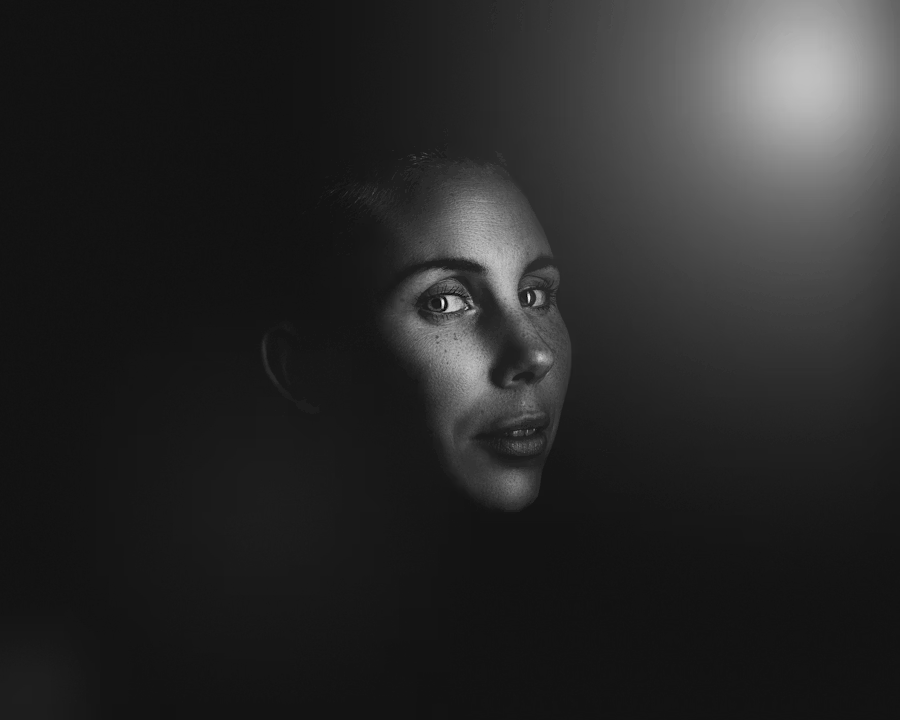
Human beings like to think of themselves as rational, independent, and fully aware of their own minds. We believe our choices are logical, our memories are accurate, and our opinions are entirely our own. But psychology tells a more complicated story.
Beneath our everyday decisions lies an invisible world of mental shortcuts, unconscious biases, ancient survival instincts, and hidden motivations. These psychological forces quietly shape how we judge people, form relationships, make purchases, follow leaders, and understand ourselves.
Many of these truths are uncomfortable because they reveal that human behavior is far less rational than we imagine. We are influenced by confidence more than facts, guided by emotions more than logic, and often controlled by instincts that evolved thousands of years ago.
Understanding these hidden patterns is not a reason for cynicism. It is a reason for awareness. The more we understand the mind, the better we can protect ourselves from manipulation, make wiser decisions, and see human nature more clearly.
Here are eleven fascinating and unsettling psychology secrets that reveal what is really happening beneath the surface.
Table of Contents
- 1 1. People Judge You in Seconds
- 2 2. Confidence Often Wins Over Accuracy
- 3 3. Many Acts of Kindness Carry Hidden Rewards
- 4 4. Scarcity Makes Things More Valuable
- 5 5. We All Wear Different Social Masks
- 6 6. Memory Is More Reconstruction Than Recording
- 7 7. The Brain Loves Categories and Shortcuts
- 8 8. Familiar Pain Can Feel Safer Than Change
- 9 9. Most People See Themselves More Positively Than Reality Suggests
- 10 10. Tired Minds Are Easier to Influence
- 11 11. Humans Crave Freedom, Yet Seek Structure
- 12 Final Thoughts
1. People Judge You in Seconds
Long before you finish your first sentence, people have already formed an opinion about you. Research suggests that first impressions happen remarkably fast, often within a few seconds. Your posture, facial expressions, clothing, voice, and confidence all contribute to these rapid judgments.
What makes this even more surprising is that first impressions are incredibly difficult to change. Even when people receive information that contradicts their original opinion, many continue to hold onto their initial judgment.
This hidden psychological tendency explains why confidence, appearance, and nonverbal communication often matter more than we would like to admit.
2. Confidence Often Wins Over Accuracy
People naturally trust those who speak with certainty. A confident voice creates the impression of competence, even when the information being presented is incorrect.
This psychological effect appears everywhere—in politics, advertising, leadership, social media, and everyday conversations. A person who expresses doubt may be ignored, while someone who speaks boldly can influence entire groups.
The uncomfortable truth is that humans often reward confidence more than truth. This is why persuasive communication can be so powerful, even when it lacks evidence.
3. Many Acts of Kindness Carry Hidden Rewards
Human beings are capable of extraordinary generosity, but psychology suggests that helping others often comes with emotional benefits for the helper as well.
Acts of kindness can produce feelings of satisfaction, social approval, reduced guilt, and stronger social bonds. Researchers sometimes refer to this as the “helper’s high”—the positive emotional state that follows generosity.
This does not make kindness fake or selfish. It simply reminds us that human motivations are often more complex than they appear.
4. Scarcity Makes Things More Valuable
The human brain is highly sensitive to scarcity. When something appears limited, rare, or difficult to obtain, we automatically assign greater value to it.
This instinct once helped our ancestors compete for food, resources, and opportunities. Today, businesses use the same psychological principle through phrases like:
- “Limited stock available”
- “Offer ends tonight”
- “Only two seats remaining”
Scarcity creates urgency, and urgency influences decisions.
5. We All Wear Different Social Masks
Many people believe there is one fixed, authentic self hidden beneath social roles. Psychology suggests something more flexible.
The version of you that appears with family may differ from the version that appears at work, with friends, or with strangers. Humans naturally adjust behavior depending on the situation, expectations, and social environment.
This is not necessarily dishonesty. It is adaptation. Human identity is often less like a statue and more like a river—changing shape while maintaining continuity.
6. Memory Is More Reconstruction Than Recording
Memories feel permanent, but they are surprisingly fragile.
Each time you remember an event, your brain rebuilds it from pieces rather than replaying a perfect recording. Current emotions, beliefs, later experiences, and suggestions from others can all reshape memory.
This means that even vivid memories can contain distortions. Confidence in a memory is not always proof of accuracy.
The mind does not simply preserve the past—it quietly edits it.
7. The Brain Loves Categories and Shortcuts
The human brain evolved to make quick decisions. One way it does this is by creating categories and patterns.
This ability allows us to navigate a complex world efficiently, but it also creates stereotypes, assumptions, and biases. People are often judged based on appearance, group identity, or limited information before we truly know them.
Even individuals who value fairness can fall into these unconscious mental shortcuts.
Awareness is often the first step toward reducing bias.
8. Familiar Pain Can Feel Safer Than Change
One of psychology’s most surprising findings is that people often remain in situations that make them unhappy simply because those situations are familiar.
A toxic relationship, an exhausting job, or unhealthy habits may continue not because they bring happiness, but because uncertainty feels frightening.
The unknown carries risk. Familiar discomfort feels predictable.
Many people stay where they are because the pain they know feels safer than the possibilities they do not.
9. Most People See Themselves More Positively Than Reality Suggests
Psychologists have repeatedly found that people tend to view themselves as above average in intelligence, kindness, morality, and competence.
This is statistically impossible, yet remarkably common.
Humans naturally protect self-esteem through subtle forms of self-enhancement. Even humility can occasionally become a way of gaining social approval.
A small degree of self-belief helps confidence, but too much can create blind spots.
10. Tired Minds Are Easier to Influence
Mental energy is limited.
When people are exhausted, stressed, overwhelmed, or sleep-deprived, critical thinking becomes weaker. Decision-making shifts toward habit, emotion, and suggestion.
This is why fatigue affects judgment, self-control, and resistance to persuasion.
When your brain is tired, your psychological defenses become less effective.
Rest is not just recovery—it is protection.
11. Humans Crave Freedom, Yet Seek Structure
People often describe freedom as one of life’s greatest values. Yet too much freedom can create anxiety.
Choices require effort. Uncertainty creates stress. This is why many people seek routines, leaders, traditions, systems, and clear rules.
Structure provides comfort in a complicated world.
The paradox of human nature is that we desire independence while also searching for guidance, certainty, and belonging.
Final Thoughts
Dark psychology is not really about villains or manipulation. It is about understanding the hidden forces that shape ordinary human behavior.
These psychological patterns influence everyone. They affect how we love, trust, judge, remember, argue, buy, follow, and belong.
The goal is not to become suspicious of others. The goal is to become more aware of ourselves.
Because once you understand how the mind works, you become less vulnerable to manipulation, more compassionate toward human imperfections, and better equipped to make choices that reflect wisdom rather than impulse.
The human mind is extraordinary—but it is also full of illusions. And learning to see those illusions may be one of the most valuable forms of self-knowledge we can gain.